Frequently Asked Questions
Everything from joining the club to planting, caring for, and describing daylilies. Search, or jump to a topic.
No questions match that search. Try a simpler word, or ask us directly.
About MADS6
How do I join the Montgomery Area Daylily Society?
Download and fill out the membership form (PDF), then bring it to any meeting or mail it as the form directs. Questions about membership can go to Terese Goodson, President, at [email protected] or 334-354-2854.
Do I have to be a member to come to a meeting?
No. We meet with club members and the general public, and visitors are always welcome. Meetings usually include a program from a hybridizer or garden expert, and some include an auction or a covered dish luncheon.
When and where do you meet?
Club meetings are held several times a year at St. Paul Lutheran Church, 4475 Atlanta Hwy., Montgomery, AL 36109. Use the back entrance. Dates and programs are on the Calendar of Events.
What is the monthly work day?
On the second Thursday of each month, members help care for the society’s official AHS Display Garden at the Montgomery Botanical Gardens at Oak Park. It is a relaxed way to learn hands-on care from experienced growers. Rain-date changes are emailed to the group.
Where can I buy daylilies locally?
Our daylily and companion plant sales are the best place to find locally grown plants that do well in the River Region. Watch the calendar for sale dates and flyers. Daylilies are also auctioned at some club meetings.
What is the American Hemerocallis Society?
The American Hemerocallis Society (also known as the American Daylily Society) is the national organization for daylily enthusiasts. MADS is an affiliated club in AHS Region 14. Visit daylilies.org and the Region 14 site to learn more.
Daylily Basics4
What is a daylily?
The scientific name for the daylily is Hemerocallis, most recently placed in the plant family Asphodelaceae. The preferred spelling is “daylily” as one word. Hemerocallis comes from two Greek words meaning “beauty” and “day,” because each flower lasts only one day.
To make up for it, each flower stalk carries many buds, and each clump has many stalks, so a clump usually blooms for several weeks. Many cultivars also bloom more than once a season.
Why is the daylily called the perfect perennial?
Daylilies are:
- Available in a rainbow of colors and many shapes and sizes.
- Able to survive with very little care in a wide range of climates.
- Suitable for all types of landscapes.
- Drought tolerant when necessary, with relatively few pest and disease problems (see Pests & Diseases).
- Adaptable to various soil and light conditions.
- In bloom from late spring until autumn.
Where did daylilies originate?
The genus Hemerocallis is native to Asia. Since the early 1930s, hybridizers in the United States and England have made great improvements. Originally the only colors were yellow, orange, and fulvous red. Today there are near-whites, pastels, yellows, oranges, pinks, vivid reds, crimson, purple, nearly true blue, and fabulous blends.
The common orange and yellow daylilies seen along roadsides are cultivated forms of wild types that have “escaped.” All modern daylilies come from a complicated history of hybridizing among these and other wild types.
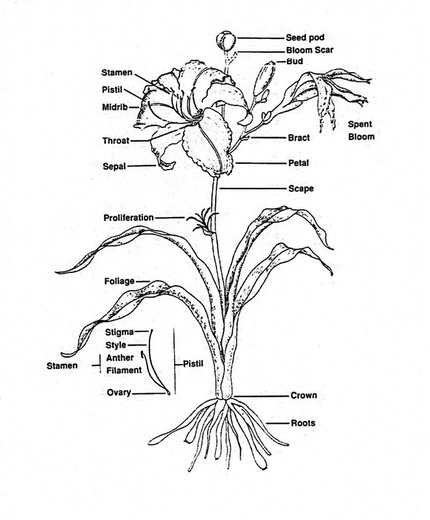
What are the parts of a daylily?
Colors & Patterns2
What flower colors do daylilies come in?
Modern hybrids have a remarkably wide color range, considering the wild types were only yellow, orange, fulvous (dull reddish yellow), and rosy-fulvous. The only colors notably missing are pure white and pure blue, which hybridizers are avidly pursuing.
Basic color is the color of the outer part of the flower:
- Yellow
- Palest lemon through bright yellow and gold to orange.
- Red
- Scarlet, carmine, tomato-red, maroon, wine-reds, and blackish reds.
- Pink
- Pale pink through rose-pink to rose-red.
- Purple
- Pale lavender and lilac to deep grape or violet.
- Melon / cream-pink
- Palest cream to deep cantaloupe.
Buff, brown, apricot, and peach are variations of pink plus yellow. Near-whites are the palest tints of yellow, pink, lavender, or melon.
Throat color: the center of the flower usually differs from the rest, most often green, yellow, gold, orange, apricot, or melon.
Stamen color: usually light yellow to greenish, sometimes matching the flower. The anthers at the tips are often darker, sometimes black.
What color patterns are found in daylily flowers?
Modern daylilies show many patterns unknown in the wild types:
- Self
- Petals and sepals are all the same color. Stamens and throat may differ.
- Blend
- Petals and sepals are a blend of two or more colors.
- Polychrome
- An intermingling of three or more colors, such as yellow, melon, pink, and lavender.
- Bitone
- Petals and sepals are different shades of the same color, petals darker. A reverse bitone has darker sepals.
- Bicolor
- Petals and sepals are different colors, such as red and yellow. Petals are the darker color.
- Eye / Band
- A zone of different or darker color between throat and tips. An eye is on petals and sepals; a band only on petals; a halo is faint; a watermark is lighter.
- Edged / Picoteed
- Segment edges are lighter or darker than the segment, from a thin wire edge up to 1/4–1/2 inch.
- Tipped
- Segment tips (usually petal tips) are a contrasting color.
- Dotted / Dusted
- Color looks unevenly applied: finely misted (dusted) or clumped into pools (dotted). Also flecked, flaked, speckled, stippled.
- Midrib
- The center vein of each segment may be a different color and may be flush, raised, or recessed.
- Diamond dusting
- Tiny crystals in the cells sparkle in sunlight like gold, silver, or diamond dust.
Forms & Traits5
What flower forms are found in daylilies?
The AHS officially recognizes these forms for exhibition:
- Single
- Three petals, three sepals, six stamens, and one pistil.
- Double
- Hose-in-hose doubles have extra layers of petals (a flower within a flower). Peony-type doubles have petal-like tissue on the stamens.
- Spider
- Petals at least four times as long as they are wide (4:1).
- Unusual form
- Defined by petal or sepal shape: crispate (pinched, twisted, or quilled), cascade, or spatulate, on at least 3 petals or 3 sepals.
- Polymerous
- More than the normal three sepals and three petals, usually four or five of each.
- Multiform
- Registered as two or more of spider, unusual form, polymerous, or double.
Sculpted describes three-dimensional features from the throat, midrib, or petal surface: pleated, cristate (formerly crested), or relief. It is recorded at registration but not used for exhibition classes.
What other terms describe daylily shape?
- Circular
- Seen from the front, the flower looks round; short, wide, overlapping segments.
- Flat
- Seen from the side, perfectly flat except for the concave throat.
- Informal
- Segments have no definable shape; irregular, widely spaced, or floppy.
- Recurved
- Segments flare and some tips roll back or tuck under.
- Star
- Long, pointed segments with space between them, like a three- or six-pointed star.
- Trumpet
- Seen from the side, resembles a true lily, rising from the throat with little flare.
What do texture, substance, size, and branching mean?
- Texture
- The surface quality of the bloom: smooth, creped, or ribbed.
- Substance
- Thickness of the tissue, or how well the flower stands up to weather, from delicate to heavy and leathery.
- Miniature
- Flowers under 3 inches across.
- Small
- Flowers 3 to 4½ inches across.
- Large
- Flowers 4½ inches and over.
- Top branched
- Branching only near the top of the scape.
- Well branched
- Branching begins near the top of the foliage.
- Low branched
- Branching extends down into the foliage.
Branching lets one scape carry anywhere from 10 to 100 buds.
Do daylilies only bloom during the day?
- Diurnal
- The normal type: opens early in the morning and lasts until evening.
- Nocturnal
- Opens late in the afternoon, stays open all night, and closes the next morning or early afternoon.
- Extended
- Individual blooms stay open at least 16 hours. Both diurnals and nocturnals can be extended bloomers.
When do daylilies bloom?
From early spring until frost, depending on climate. Growers use these terms (and abbreviations) for bloom time:
- Extra Early (EE)
- First to bloom: March or April in the far South, May or June in the North.
- Early (E)
- Three to five weeks before the main midseason bloom.
- Early Midseason (EM)
- One to three weeks before the peak.
- Midseason (M)
- At the peak of bloom in your garden, May in the South to July in the North.
- Late Midseason (LM)
- One to three weeks after the peak.
- Late (L)
- Four to six weeks after the peak.
- Very Late (VL)
- Last to bloom, late summer in the South, fall in the North.
- Rebloomer (Re)
- Blooms more than once in a season, either early then again in fall, or in several waves.
Planting4
When is the right time to plant daylilies?
In the far South (including the River Region): early spring or very late fall is best. Daylilies planted in July, August, or September, when temperatures and humidity are very high (over 90°), have a high chance of rotting.
In the North: spring planting is normally preferred, since fall-planted daylilies may not root in before winter. Experienced gardeners can plant in fall if they know the plant’s hardiness, mulch, and know the last safe planting date for their area.
Where is the best place to plant daylilies?
- Sun or shade
- Most daylilies do best in full sun and need at least six hours of direct sun a day. Light yellows, pinks, and pastels need full sun to color up. Many reds and purples benefit from some shade in the hottest part of the day, since dark colors absorb heat.
- Soil
- Daylilies perform best in soil with good aeration, fertility, and microbial activity that holds moisture yet drains well. Improve very sandy or clay soils with compost.
- Drainage
- Plant in well-drained soil. Raised beds help where drainage is poor, but they need more summer watering.
- Neighbors
- Daylilies may struggle near trees that compete for water and nutrients (though they often do fine under pines). Plants competing with tree roots do better with extra watering.
How do I plant my daylilies?
Bare-root plants that arrive by mail can be “parked” in damp sand until you are ready. Many growers soak the roots for a few hours or overnight first. Make sure plants are clean and healthy, and work the soil loose to a depth of at least 1 foot.
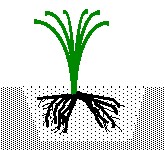
- Dig a hole larger than the root mass and make a mound in the center.
- Set the plant on the mound with roots spread on all sides.
- Plant about as deep as it grew before; the white band at the base of the foliage shows the old soil line.
- Don’t set the crown (where foliage meets roots) more than 1 inch below the surface.
- Work soil around the roots, firm it, and water well so there are no air pockets.
- When the water soaks in, finish filling, leaving a slight depression around the plant.
How far apart should daylilies be planted?
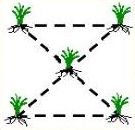
Space daylilies no less than 18 to 24 inches apart on each side. A staggered pattern like the one shown fills a bed nicely.
Label each plant with a permanent marker. A daylily loses much of its value when its name is lost.
Care3
How much should I water daylilies?
Water almost certainly increases the number and size of blooms. It matters most in spring, when plants are making scapes and buds, and during summer bloom.
- Deep watering that reaches 8 to 10 inches down beats frequent light sprinklings.
- Overhead watering in the heat of the day spots and wilts open blooms.
- Evening watering can spot the next day’s flowers.
- Be careful not to overwater.
Do daylilies need fertilizer?
- Have your soil tested to learn what it needs; your county Extension office can explain how.
- Daylilies tolerate a wide pH range. Only adjust pH (with sulfur or lime, after a soil test) if plants are doing poorly.
- In most home gardens, one application in spring is plenty, and even that may not be needed every year.
- Very poor or sandy soils that leach may need more frequent feeding.
What about mulching, grooming, and weeds?
- Mulching
- Not essential everywhere, but it improves the soil and helps hold moisture.
- Grooming
- Many gardeners remove the day’s spent blooms each evening. If you hybridize, leave pollinated blooms until the seed pod forms.
- Weeds
- Mulching and hoeing are the most effective controls in a home garden.
- Sanitation
- Clear dead foliage in spring, remove damaged or diseased leaves during the season, and cut spent scapes back to a few inches after bloom (unless you are hybridizing).
Pests & Diseases2
What pests affect daylilies?
Daylilies have a few pests, but most do only minor damage.
- Aphids
- Daylilies have their own aphid, most active in cool weather (spring and fall, or all winter in the subtropics). Because they hide inside the fans, control usually needs a product with at least mild systemic action.
- Spider mites
- Among the most common pests, most active in hot, dry weather. Hosing them off helps.
- Thrips
- Start control early in the season with a systemic or long-residual product.
- Slugs and snails
- Feed at night on tender growth, leaving ragged holes. Good sanitation helps; otherwise use a product made for them.
- Others
- Cutworms, tarnished plant bugs, cucumber beetles, Japanese beetles, grasshoppers, and cicadas. Bulb mites may be involved in crown rot. Deer sometimes eat flower buds.
Important: do not use the pesticide Kelthane, which is known to harm daylilies.
What diseases affect daylilies?
Gardens with a mix of plants rarely have much trouble. Large single-genus collections from many sources are more likely to see problems. Older, widely grown cultivars are often a safer start for new growers than the newest introductions.
- Daylily rust
- A fungus (Puccinia hemerocallidis) that makes orange-yellow powdery spots on leaves and scapes; the spores leave an orange mark on a white tissue. Leaves may die back but the plant usually survives. Give plants good air circulation and spacing, minimize overhead watering, avoid excess nitrogen, and use an appropriate fungicide if needed.
- Crown and root rots
- The plant yellows and may collapse, leaves pull out easily, and tissue turns mushy. Especially a concern in warm climates. Ensure good drainage and air circulation, don’t overwater or over-fertilize, don’t plant too deep, and let divisions air-dry in shade before replanting. Get a lab diagnosis for persistent rot, since treatment depends on the cause.
- Leaf streak
- A fungus causing brown spots, yellow streaks, and leaf die-back but not plant death. Often follows pest or frost injury; fungicides may help.
- Spring sickness
- Twisted, bent, stunted, discolored fans in early spring. The cause is unknown and it is probably not a disease; affected fans may recover and bloom normally.
Also learn what is normal: new growers sometimes mistake summer dormancy for disease.
Daylily answers are adapted from the American Hemerocallis Society’s FAQ. The original printable versions are still available: Part 1 (PDF) · Part 2 (PDF). Have a question that isn’t here? Contact us.